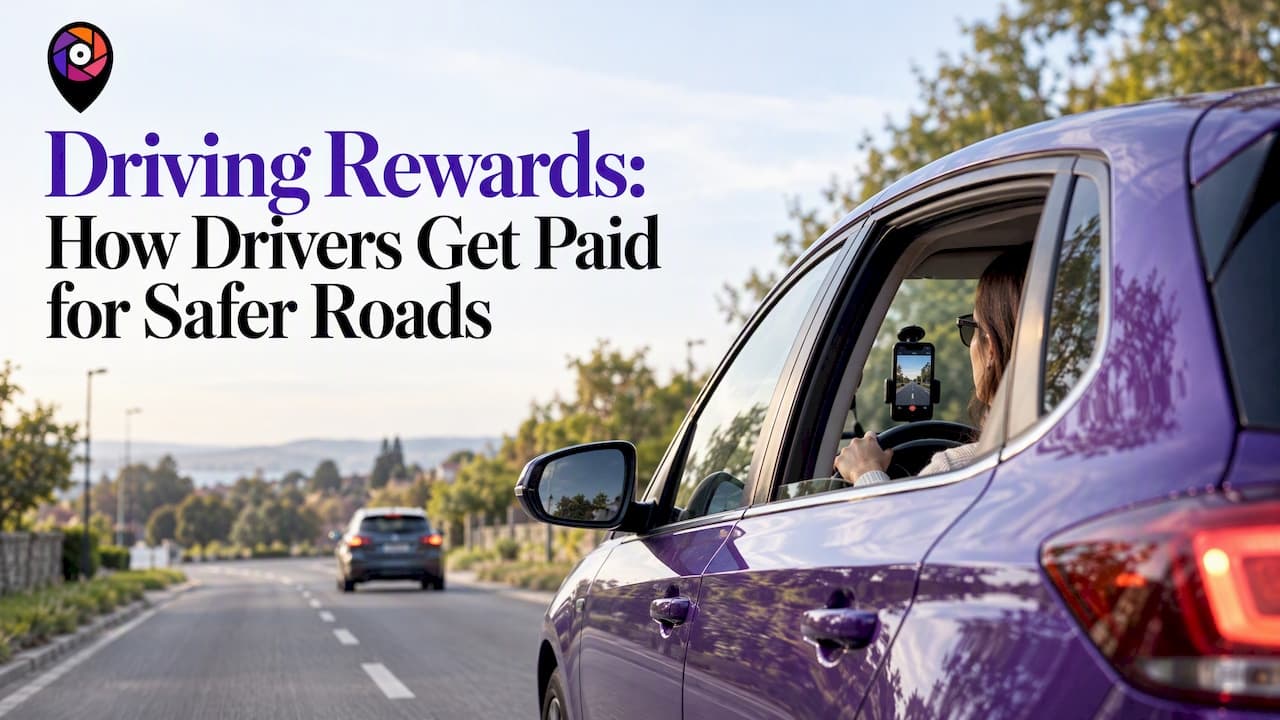
Driving rewards are incentives paid to drivers for safer behavior or for helping make roads safer. They come in two main forms. The first is insurer and telematics programs, where a phone app or plug-in device scores your driving and pays out in discounts, points or gift cards. The second is reporting schemes, where you document dangerous driving or violations and receive a share of what the system collects. This guide explains how each works, what you can realistically earn, what the research says about whether rewards change behavior, and what to check before you hand over your data.
TL;DR
- Most driving rewards in the US come from insurance-style telematics: an app or device records how you drive, and good habits can lower your rate. Some insurers can also raise rates for unsafe results, so read the terms first (CNBC Select).
- A second kind of reward pays people for documenting and reporting traffic violations. Mongolia, for example, introduced a rule in November 2025 that pays reporters 10 to 20% of the offender's fine (MONTSAME).
- Research suggests rewards work best for moderate-risk drivers, and that improvements can fade when incentives stop.
- Before joining any program, check what data is collected, whether it is anonymized, how rewards are paid and whether they are taxable.
- Our app, DashcamU, turns your phone into a dashcam that records, detects crashes and lets you report violations anonymously, with a reward system built around successful submissions.
Table of Contents
- What driving rewards actually are
- How telematics-based reward programs work
- Do driving rewards make roads safer?
- Rewards for reporting violations
- Privacy: the question to ask first
- How to choose a driving rewards program
- Perspective: why we think rewards should reach drivers who document the road
- Put your phone to work with DashcamU
- Using rewards well: practical habits
- Who benefits from driving rewards
- What to check before relying on reward data
- FAQ
- Sources
What driving rewards actually are
The phrase covers a lot of ground, so it helps to sort programs by who pays and what you do to earn.
Behavior-based rewards. An insurer, a fleet software company or a mobility company measures how you drive. Typical measures are speeding, hard braking, rapid acceleration and phone use while moving. In return you may get a lower premium, points, gift cards or cash. Insurers generally run these as safe-driving discount programs: they use telematics from a plug-in device or a smartphone app to record and evaluate your habits, and responsible driving may lower your rates (CNBC Select).
Participation rewards. Some programs reward you simply for enrolling, for recording trips or for staying engaged with the app. The payout is small, often a point balance redeemed for retail gift cards, but it is usually separate from your insurance price.
Contribution rewards. Here you are paid for adding something useful to road safety: video evidence of a violation, a verified incident report or an accident alert. This is the newest category, and it depends on local law, because a reward needs a legal route for submitting evidence and a source of funds, usually the penalty paid by the offender.
Fleet rewards. Employers and fleet managers use scorecards and recognition to encourage drivers to follow safety, compliance and fuel-efficiency rules. If you drive for work, your employer may run one. If you are an individual driver, the first three types matter more.
The search results for this topic are dominated by the first two types. The third is where the idea of a driving reward starts to look different, and we come back to it below.
How telematics-based reward programs work
The mechanics are similar across most programs.
- You install an app or plug in a device. The smartphone app uses the phone's sensors, such as GPS and the accelerometer, to detect when you are driving.
- The program records trips. It logs speed, braking, acceleration, cornering and, in some apps, phone handling.
- A score is produced. The software turns the data into a driving score or a set of driving insights.
- The reward is applied. Depending on the program, that means a premium discount at renewal, points toward gift cards, or a cash-like payout.
The important difference is what happens when the score is poor. Some programs are "discount only": a bad score simply means no reward. Others can raise your rate. CNBC's overview notes that while responsible driving may lower rates, unsafe results may raise rates with some insurers (CNBC Select). That single line in the terms and conditions is worth finding before you enroll.
What can qualify you for a reward
Qualifying behavior varies by program, but the common categories are:
- Driving within the speed limit and avoiding hard braking.
- Smooth acceleration and cornering.
- Not handling the phone while the vehicle moves.
- Avoiding late-night driving, where a program scores that.
- Recording a minimum number of trips or miles in a period.
- For contribution programs, submitting evidence that is clear, time-stamped, located and verifiable.
Terms, caps and eligibility rules differ by program and by state, and they change. Always read the current rules on the provider's own page rather than relying on a summary.
What you can realistically expect to earn
Expect modest sums from participation and points programs. Typical payouts are gift-card-sized and are capped per month or per six months, with younger drivers sometimes on different schedules from older ones. Premium discounts can be larger over a year but depend on your insurer, your state and your score. We do not publish a figure here because no single number applies to everyone, and a program that promises a fixed income from driving alone deserves suspicion.
Do driving rewards make roads safer?
This is the question that matters beyond your wallet, and the research is encouraging with some caveats.
Engagement matters. Researchers at Cambridge Mobile Telematics found that its most engaged riskiest drivers reduced distracted driving by 20%, hard braking by 9% and speeding by 27%, which was estimated to produce a 5.5% reduction in bodily injury claims (CMT study). Note that this comes from a telematics vendor's own analysis, so read it as a strong signal rather than the final word.
Feedback plus money beats either alone. A randomized trial of telematic-based feedback and financial incentives found significant relative reductions in speeding (11 to 13%), hard braking (16 to 21%) and rapid acceleration (16 to 25%) among adult drivers (University of Melbourne research record). Purdue researchers similarly found that negative feedback and economic incentives correlated with improved driving behavior (Purdue Business).

Different drivers respond differently. A 2025 naturalistic study found that incentive-based telematics significantly influenced moderate-risk drivers, that low-risk drivers stayed stable, and that high-risk drivers achieved moderate improvements in speeding intensity (MDPI Sensors). The authors argue that schemes work best when tailored to risk level.
Habits can fade. A UK government research report on telematics found that telematics may reduce accidents in commercial fleets in supportive environments, especially with feedback and incentives, but that behavior change tends not to last after they are withdrawn (UK government report, 2015). The practical lesson is that rewards should be ongoing and tied to feedback, not a one-time bonus.
What this means for you
If you already drive carefully, a reward program mostly pays you for what you do anyway, and that is fine. If you tend to speed or brake hard, the feedback is probably worth more than the payout. Either way, pick a program that gives you clear, frequent feedback and a reward you will actually want.
Rewards for reporting violations
Behavior scoring rewards you for your own driving. Reporting schemes reward you for helping enforce the rules on everyone else's. The logic is simple: if a violation is documented with credible evidence and the offender pays a penalty, part of that penalty can go to the person who supplied the evidence.
Mongolia offers a recent example. A regulation effective November 1, 2025 grants citizens monetary rewards for reporting traffic violations through the 102 mobile app, providing 10 to 20% of the offender's fine, with payments distributed on a VAT-refund schedule (MONTSAME). The same reporting notes that such rewards are often subject to standard taxation, such as income tax deductions, before transfer to the citizen's bank account.
Two takeaways apply anywhere:
- Rules are local. Whether citizen reports are accepted as evidence, whether rewards are legal and how much they pay depend on the country, and often on the state or city. Check what your local traffic authority accepts before you record and submit.
- Rewards may be taxable. Treat any cash reward as potentially taxable income and ask a tax professional how it applies to you.
Our view is that reporting rewards are a natural next step as legal frameworks mature, because they give ordinary drivers a reason to document what they see rather than just complain about it.
Privacy: the question to ask first
Every reward program asks for data. Location, speed, braking patterns and sometimes video are sensitive, and the Purdue research found that drivers with privacy concerns may be less likely to install telematics, while also noting that demonstrating a direct personal benefit from sharing private data at scale is novel at best and needs more study (Purdue Business).
Good practice looks like this. Telematics applications such as the one described in the 2025 MDPI study keep personal identifiers separate from behavioral data and use randomly generated unique IDs to ensure anonymity, in compliance with EU GDPR (MDPI Sensors). That design is a useful benchmark for any app you consider.
Before enrolling, check:
- What is collected: location only, or also video, audio and contacts?
- Who sees it: your insurer, the app company, authorities or third parties?
- How it is stored: are identifiers separated from driving data?
- What you can delete: can you leave and remove your history?
- What the data can do to you: can it raise a rate, or only lower one?
How to choose a driving rewards program
Use this checklist to compare options by type rather than by brand.
| Question | Insurer telematics program | Points and gift card app | Violation-reporting app |
|---|---|---|---|
| What earns the reward? | A good driving score | Recorded trips and safe habits | Verified evidence of violations |
| Typical reward | Premium discount | Points for gift cards | Share of a penalty, where the law allows it |
| Can it cost you? | Possible rate increase with some insurers | Usually not | Usually not, but rules on evidence apply |
| Main data collected | Trips, speed, braking, phone use | Trips and driving insights | Video, location, time stamps |
| Local law matters? | State insurance rules | Rarely | Strongly |
Then run through these steps:
- Read the downside terms. Look for any clause that lets the program raise rates or end rewards.
- Check the cap and the redemption route. A reward you cannot easily redeem is not worth much.
- Test the battery and storage impact. Apps that run in the background can drain your phone, so watch your first week of use.
- Confirm the privacy model. Prefer apps that anonymize data and let you delete it.
- Match it to your goal. If you want a lower premium, ask your insurer. If you want to make roads safer and be recognized for it, look at reporting and crash-alert apps.
Perspective: why we think rewards should reach drivers who document the road
Most driving reward programs look inward. They score how you drive, and that is useful, because the research shows feedback and incentives can reduce speeding and hard braking. But the roads are not made unsafe only by your own habits. They are made unsafe by the driver who runs the red light in front of you, and by the minutes lost after a crash when nobody has called for help.
That is why we built DashcamU around a phone you already carry. It records like a dashcam, detects crashes (we designed our detection to reach 98.2% accuracy), and lets you submit evidence of violations anonymously, so that reporting does not make you a target. Anonymity is not an add-on for us. It is the reason a careful driver is willing to participate at all, and the Purdue findings on privacy concerns point the same way.
We also believe a reward should follow a contribution that actually helps. Our reward system is designed to recognize successful penalty submissions, funded by civil penalties as legal frameworks allow, so the person who supplies the evidence is not the only one carrying the cost of road safety. Add nearby accident alerts, and you have a driver who is both protected and useful to the people around them.
The best driving reward is not a gift card. It is a road where fewer people get hurt, and a system that thanks you for helping build it.
Oleksiy
Put your phone to work with DashcamU
If you want to be rewarded for more than your own score, DashcamU is built for it. The app turns your smartphone into a dashcam, records what happens on the road, and lets you report traffic violations anonymously. Its automatic crash detection is designed to help rescue and medical services respond faster, and the app also offers nearby accident alerts and works with Bluetooth buttons and DVRs. Our reward system is designed to recognize successful penalty submissions.

The app is free for individual drivers. Explore the DashcamU app to see how it works, or visit the DashcamU home page for the latest on features and availability in your region. Reward availability depends on local rules, so check what applies where you drive.
Using rewards well: practical habits
A few habits make any program more rewarding and less risky.
Drive the way you want to be scored. Apps measure the basics: speed, braking, acceleration and phone handling. Set your phone to a mount, silence notifications, and leave more following distance. These choices raise your score and cut your actual risk.
Never record or report while driving. If you want to document a violation, use a hands-free or Bluetooth button, or wait until you are parked. A reward is never worth a crash. Many states restrict handheld phone use, so check your state's law.
Keep evidence useful. For any reporting scheme, the clearer the evidence, the likelier it is to be accepted. That means a readable plate, a visible location and an accurate time. Avoid editing footage.
Keep an eye on the money side. Track what you earn and set aside what may be owed in tax. If a program pays by direct deposit or a payment platform, keep the statements.
Review your settings every few months. Permissions change with updates. Confirm that location, camera and microphone access are what you intended.

Who benefits from driving rewards
Everyday drivers gain feedback, possible savings and, with reporting apps, a voice in road safety.
Gig and rideshare drivers spend long hours on the road, so even small monthly rewards add up, and driving insights can help them spot risky habits.
Insurers gain accurate behavioral data. The CMT analysis linked engagement to fewer injury claims, which is why insurers fund these programs (CMT study).
Authorities gain evidence they could not collect themselves, as the Mongolian scheme shows, since citizen reports extend enforcement beyond where officers are standing (MONTSAME).
Fleet managers gain a tool for recognizing safe drivers. Remember that behavior change can fade when incentives are withdrawn, so the program should be steady.
What to check before relying on reward data
If you are an insurer, an authority or a driver who plans to use reward-program data, ask a few questions first.
- Is the data authentic? Time stamps, location and unedited video matter. An app that verifies submissions is worth more than one that accepts anything.
- Is the sample fair? Programs attract people who already drive well, so data may not represent all drivers. The 2025 MDPI study found low-risk drivers stayed stable while moderate-risk drivers changed most (MDPI Sensors).
- Is privacy protected? The Purdue researchers say more study of privacy concerns is needed, so treat consent and data minimization as requirements (Purdue Business).
- Will the effect last? Plan for ongoing feedback, because gains can fade once incentives stop (UK government report, 2015).
FAQ
Is there an app that rewards you for driving?
Yes. Several types exist. Insurer apps score your driving and may lower your rate. Points apps trade safe-driving minutes or trips for gift cards. Reporting apps, like DashcamU, are built around documenting violations and incidents, with rewards designed to follow successful submissions where local rules allow. Read each program's current terms before joining.
Can driving rewards raise my insurance rate?
With some insurers, yes. Safe-driving programs record and evaluate your habits, and while good results may lower your rate, unsafe results may raise it with some insurers (CNBC Select). Ask your insurer whether the program is discount-only before you enroll.
Are driving rewards taxable?
Often they can be. Reporting from Mongolia notes that monetary rewards for reporting violations are typically subject to standard taxation, such as income tax deductions, before payout (MONTSAME). Rules differ by country, so ask a tax professional how cash rewards are treated where you live.
Do rewards really make people drive better?
Often, yes, especially for moderate-risk drivers. A randomized trial found significant relative reductions in speeding, hard braking and rapid acceleration when drivers received feedback and financial incentives (University of Melbourne research record). Gains may fade if the program ends, so steady feedback helps.
Is it safe to share my driving data?
It can be, if the app protects it. Look for separation of personal identifiers from driving data, random IDs and a clear deletion option, the approach described in a 2025 telematics study (MDPI Sensors). Read the privacy policy before you grant location or camera access.
Sources
- How Do Safe Driving Discounts Work, and Are They Worth It? (CNBC Select)
- Citizens Reporting Traffic Violations to Receive Monetary Rewards (MONTSAME)
- Incentive-Based Telematics and Driver Safety (MDPI Sensors)
- The Importance of Engagement in Safe Driving (CMT study)
- Provision of telematics research (UK government report)
- News Features (Purdue Business)
- The effect of telematic based feedback and financial incentives on driving behaviour (University of Melbourne)