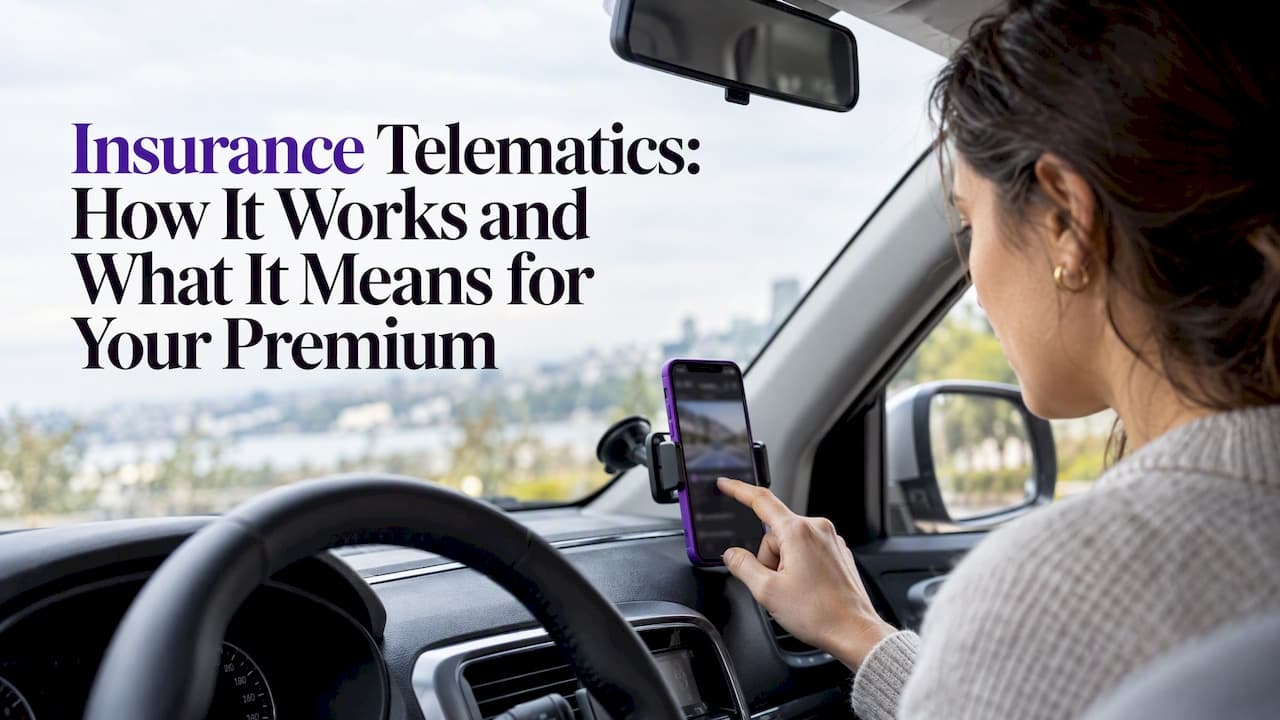
Insurance telematics is auto insurance that prices your policy partly on how you actually drive, measured by a device, a connected car or a smartphone app, instead of relying only on averages for your age, ZIP code and vehicle. The National Association of Insurance Commissioners (NAIC) calls the broader category usage-based insurance (UBI). It tracks mileage and driving behavior and ties premiums more closely to what it observes. Below you will find what gets measured, how scores work, what it can cost or save you, and how to enroll without giving away more than you intend.
TL;DR
- Telematics insurance uses a plug-in device, a built-in car system or a phone app to record how you drive, then feeds that into your price alongside traditional rating factors.
- Typical signals include miles, time of day, speed, hard braking, rapid acceleration and hard cornering. Scoring methods differ from one insurer to the next.
- Safe driving can earn a discount, but it is not guaranteed. Depending on the program, a poor score can mean a higher premium or a lost discount.
- Before you enroll, read how your data is stored, who sees it and what happens at renewal.
- Telematics is a pricing tool. It is not the same as reporting violations or documenting a crash, which is where a dashcam app fits.
Table of Contents
- What insurance telematics is, and what it is also called
- How telematics insurance works, step by step
- What data a telematics program can collect
- How telematics driving scores are calculated
- Can telematics lower your premium?
- Choosing and using telematics well
- Telematics is not traffic enforcement
- Our perspective: telematics data is only half the road safety picture
- Document your drive with DashcamU
- FAQ
- Sources
What insurance telematics is, and what it is also called
The word "telematics" combines telecommunications and informatics. In car insurance it simply means collecting vehicle and driving data remotely and using it to assess risk. The Association of British Insurers describes it as motor insurance that takes into account how the vehicle is used when setting premiums, and notes it is also known as "pay how you drive" or "black box" insurance.
In the US you will see several labels for the same idea:
- Usage-based insurance (UBI), the term regulators prefer
- Pay-as-you-drive, usually focused on mileage
- Pay-how-you-drive, focused on behavior
- Safe-driver programs, the marketing name many carriers use
Washington State's Office of the Insurance Commissioner says UBI, also called telematics, uses an app or device to monitor driving behavior and determine the premium. The idea is simple. Two drivers with the same age, car and address can still drive very differently, and telematics tries to see that difference.
How telematics insurance works, step by step
The details vary by carrier, but the flow is consistent.
1. You enroll and choose a collection method
The NAIC says telematics can run through installed connected boxes, OBD dongles, connected-car systems or mobile applications. Some programs ask you to plug a small device into your car's diagnostic port. Others use sensors already in your vehicle. Many now simply ask you to install an app, which uses your phone's motion sensors and location.

2. The device or app measures driving
According to the ABI, a built-in computer, black box or smartphone app measures vehicle use and driving performance, including miles, road types, time of day, speed and braking. Data is usually collected during an initial monitoring period and then continuously.
3. The insurer turns data into a score or rating
Your trips are summarized into a driving score, a tier or a set of behavior flags. The insurer combines this with traditional rating factors. Washington's regulator says insurers may combine telematics data with traditional rating factors, and that premiums may rise or fall with driving behavior. The NAIC's CIPR study adds that most insurers do not base the whole premium on driving behavior alone. They generally keep using rating factors approved in the relevant jurisdiction.
4. Your price changes, or you earn a different reward
The ABI explains that some policies adjust premiums at set points during the policy, some keep premiums fixed but offer non-monetary rewards, and others change the price only at renewal. That is why two telematics programs with similar sign-up pages can feel very different six months in.
What data a telematics program can collect
The NAIC says devices may measure miles, time of day, GPS location, rapid acceleration, hard braking, hard cornering and airbag deployment. Washington's regulator gives a near-identical list of what an insurer may track, including location and mileage.
In practical terms, that breaks down like this:
| Data type | What it tells the insurer | Why it matters |
|---|---|---|
| Mileage | How much you are exposed to risk | Fewer miles generally means fewer chances for a claim |
| Time of day | Whether you drive late at night | Night driving is treated differently by many models |
| Speed | How fast you drive, sometimes relative to the limit | A direct behavior signal |
| Hard braking | Sudden stops, often from tailgating or distraction | One of the most common scored events |
| Rapid acceleration and hard cornering | Aggressive handling | Used as a proxy for risk |
| Location | Where you drive and park | Raises the most privacy questions |
| Airbag deployment | That a significant crash occurred | A crash indicator |
The ABI's consumer guide says most policies provide driving feedback through a web portal or smartphone app, and that named-driver data may be visible to the policyholder, including where and when the vehicle is driven. That is worth knowing if more than one person drives the car.
How telematics driving scores are calculated
There is no universal formula. Each insurer builds its own model, and that is the most important thing to understand about your score.
The NAIC's CIPR study explains that models range from simple counters for mileage, time of day and events to granular, second-by-second analysis. The more advanced versions put each moment in context: road type, darkness, weather and the speed limit. A hard stop on an empty highway at noon may be read differently from one in rush hour traffic at night.
The same study identifies predictive loss-cost modeling as a central challenge. Insurers must work out which driving behaviors truly correlate with losses, rather than simply penalizing what looks scary. That is why scoring changes over time as carriers test new signals.
What this means for how you drive
Without knowing any one insurer's formula, you can still act on the signals that nearly every program measures:
- Leave more following distance, so you brake gently instead of suddenly.
- Accelerate smoothly away from lights.
- Slow down before a turn, not during it.
- Where you have a choice, avoid late-night trips.
- Keep trips purposeful, since mileage often feeds into price.
The ABI warns that driving behavior affects premiums differently across insurers, so read the policy terms to see how scoring, pricing and rewards connect in your program.
Can telematics lower your premium?
It can, for drivers who meet the insurer's standards. The ABI notes that safe drivers may receive lower premiums or renewal discounts, while also stating that telematics policies are not always cheaper. Washington's regulator makes a similar point: telematics can price risk more individually, but not every driver will qualify for a discount.
The NAIC frames UBI as a way to turn mileage-related fixed costs into variable ones, and to use current individual behavior next to other rating factors. For a low-mileage driver or a careful commuter, that can be a fair deal.
Costs and terms to check before you sign up
The ABI lists several charges and structures that may apply depending on the policy: premium increases, one-off charges, extra mileage charges, device fitting or removal charges, and non-monetary rewards instead of price changes. Those are UK examples, and US programs differ by carrier and state, so ask your insurer these questions directly:
- Can my rate go up because of my score, or only stay the same or go down?
- When is the price adjusted: during the term, at renewal, or both?
- Is there a fee for the device, or for returning it?
- What happens if I stop participating?
- Who counts as a driver on the policy, and is each driver scored?
Choosing and using telematics well
Telematics suits some drivers better than others. It tends to reward those who drive few miles, avoid late-night trips and keep a steady driving style. The way to get value from it is to go in informed.
Pick the collection method you trust. A phone app is the easiest to start with and needs no installation. A plug-in or built-in system may capture some signals more consistently. Think about what you are comfortable carrying and sharing.
Know your privacy rights. Washington's regulator warns that tracking location and driving behavior can create privacy concerns, and that insurers are still developing how raw telematics data will be used for pricing. The NAIC adds that privacy concerns have led some states to require disclosure of tracking practices and devices and to limit the data collected. Ask your carrier what it collects and for how long it keeps it.
Understand how the data travels. The ABI's consumer guide says specialist companies may access the data, that it may be shared with named policyholders or service partners on a lawful basis, and that it is protected under applicable privacy rules. Its guidance is written for the UK, but the questions are universal: who processes it, who sees it and why.
Read the downside clauses. The consumer guide lists privacy concerns, differing scoring methods, possible premium increases and one-off charges. It also notes that cancellation for high-risk driving is possible, and that high-risk drivers may miss discounts or other benefits. None of this is a reason to avoid telematics. It is a reason to choose a program whose terms you have read and whose scoring you can follow in the app.
Use the feedback. Most programs show trip-by-trip results. Treat the app like a coach: check which events lowered your score and adjust.
Telematics is not traffic enforcement
A common worry is that an insurer's box or app could become a speed trap. Telematics policies do measure speed and braking patterns, but the ABI says insurers will not share telematics data with police or other authorities unless there is a clear lawful basis, such as crime prevention or detection, or they are compelled by law. That statement is about UK insurers. Rules in the US depend on the state and on your policy's data terms, so check your carrier's privacy notice.
The key distinction is purpose. Insurance telematics exists to price risk. It does not exist to document violations by other road users, to produce evidence after an incident or to trigger help when a crash happens. Those are different jobs, and they need different tools.
Our perspective: telematics data is only half the road safety picture
Insurance telematics answers one question well: how does this driver behave? It does not answer what happened around that driver, who caused it, or whether help is already on the way. We built DashcamU around those gaps.
A smartphone is already a motion sensor, a GPS unit and a camera. Our app turns it into a dashcam that records the road, detects crashes automatically, and lets drivers submit evidence of traffic violations anonymously. We design our crash detection to be accurate, and we report an accuracy of 98.2%, because a fast and correct alert can bring rescue and medical services sooner.
We believe drivers should be rewarded for making roads safer, not only for avoiding hard braking. That is why our model includes a reward system for successful penalty submissions, along with nearby accident alerts and, in development, smart parking availability. Anonymity and data authenticity are central to how we design the product, because evidence is only useful if people feel safe sending it and authorities can trust it.
For insurers, our direction is partnerships built on accurate, authentic incident data. For drivers, it means video and sensor evidence that can support their side of the story. We see telematics scoring and dashcam evidence as complementary: one rewards how you drive, the other documents what happens on the road you share.
the author
Document your drive with DashcamU
If telematics is about measuring your own driving, a dashcam app is about protecting you from everyone else's. DashcamU is a mobile app that turns your phone into a dashcam, detects crashes automatically, supports anonymous reporting of traffic violations and sends nearby accident alerts. It also works with Bluetooth buttons and DVRs, so you can fit it to the way you already drive.

You can see what the app does and how to get started on the DashcamU app page, or learn more about the project on the DashcamU home page.
FAQ
How does telematics insurance work?
A device, a built-in car system or a phone app measures how you drive, including miles, time of day, speed and braking. The insurer combines that data with traditional rating factors to set or adjust your premium. Depending on the program, changes may happen during the term, at renewal, or not at all if the reward is non-monetary.
What are telematics driving scores based on?
Scores are built from behaviors such as hard braking, rapid acceleration, hard cornering, speed and the time of day you drive. Some models only count events, while others analyze driving second by second against road type, darkness, weather and speed limits. Because each insurer uses its own method, the same trip can score differently across programs.
What are the downsides of telematics insurance?
The main ones are privacy concerns, scoring methods that differ between insurers, and the possibility of a higher premium or a missed discount if your driving scores poorly. Some policies also carry one-off or device charges. Reading the terms before you enroll, including how data is shared, helps you pick a program that fits your driving.
Will my insurer share my telematics data with the police?
The ABI says UK insurers do not share telematics data with police or other authorities without a clear lawful basis or a legal requirement. US rules vary by state and by insurer, so check your carrier's privacy policy and the data terms of your policy.
Is a telematics app the same as a dashcam app?
No. A telematics app measures your driving to inform pricing. A dashcam app records the road, can detect crashes and can help you document incidents and violations. Many drivers find the two work well side by side.
Sources
- Pay as you drive insurance, Association of British Insurers
- What is telematics motor insurance and how does it work?, Association of British Insurers
- Telematics, National Association of Insurance Commissioners
- Usage-based insurance, Washington State Office of the Insurance Commissioner
- CIPR Study on usage-based insurance and vehicle telematics, NAIC