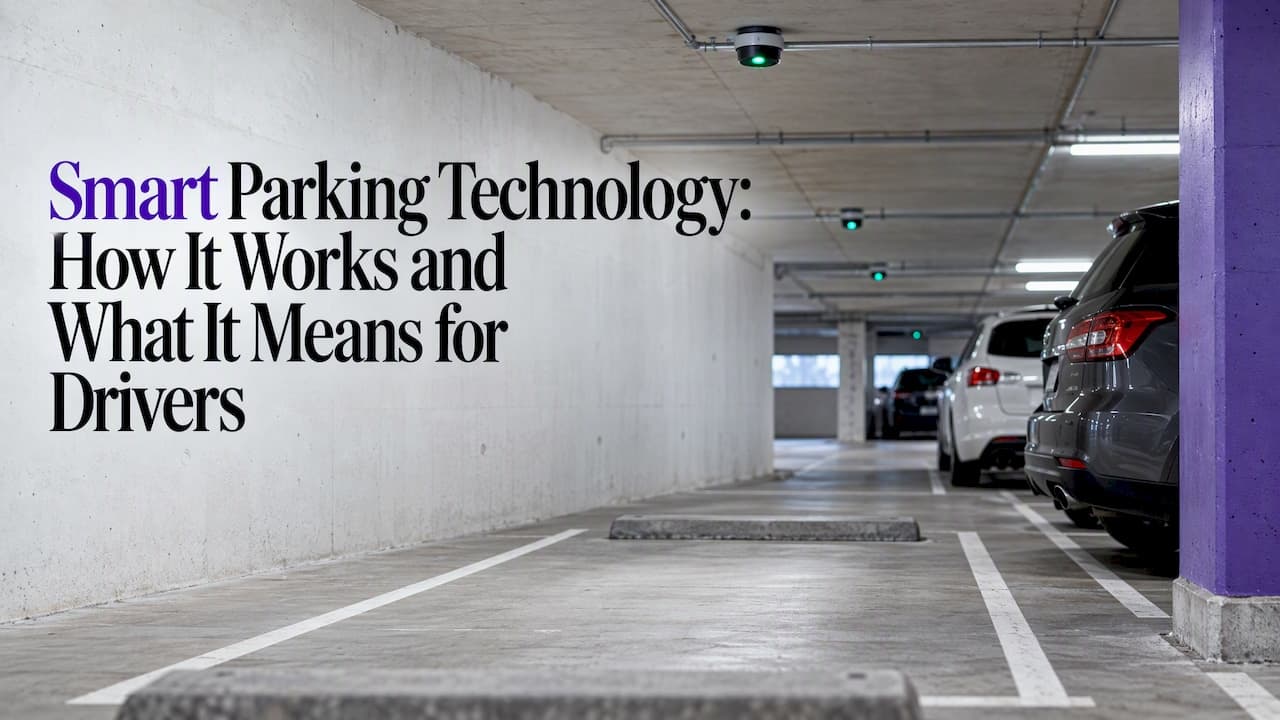
Smart parking technology uses sensors, cameras, wireless networks and software to find out which spaces are free and tell drivers in real time. Federal transportation researchers describe it as parking management that uses cameras, wireless communications and data analytics to cut congestion, search time and travel time. For you as a driver, it usually shows up as a parking availability app on your phone. For a city or a garage operator, it is a data system behind the curb.
Below we explain the pieces, how fresh the information really is, what it costs, where privacy comes in, and how to pick an app that works for you.
TL;DR
- Smart parking combines occupancy detection (sensors, cameras, license plate recognition), a cloud platform and an app or sign that shows open spaces.
- Accuracy depends on how often data refreshes and how fast it is processed. A spot shown as free can be taken before you arrive.
- Benefits for drivers are less circling. For cities they include lower congestion, better enforcement and better access for emergency responders.
- Costs, privacy and crowdsourced data quality are the main limits to weigh.
- DashcamU is a free app that turns your phone into a dashcam. Smart parking availability is part of our roadmap.
Table of Contents
- What smart parking technology actually is
- How a smart parking system detects open spaces
- What a parking availability app does for you
- How accurate is real-time parking data?
- Why it matters: congestion, safety and cost
- The real limits: cost, complexity and privacy
- How to choose a parking availability app
- Our perspective on smart parking
- Where DashcamU fits
- Where smart parking is heading
- FAQ
- Sources
What smart parking technology actually is
The term covers several different things, and search results mix them together. Two meanings matter most.
Smart parking (guidance and management). Sensing and networking find a free space and share that information. The IEEE Technology Navigator separates this from machine-driven parking: parking guidance uses sensing and networking to find a free space, while automated parking systems use machinery and control software to store or move a vehicle with little or no driver input.
Automated parking (robotic garages and self-parking). Mechanical structures and vehicle automation take over the maneuvering. This is a different category with a very different price tag, and it is not what most people mean when they type a query into a phone.
The U.S. Department of Transportation research also offers a useful caution: no single technology is proven most effective. Cities get the best results by combining the tools that fit their streets, garages and budgets.

How a smart parking system detects open spaces
Every system answers the same question: is this space occupied right now? The answer comes from one of a few methods.
In-ground and surface sensors
Magnetic and other sensors sit in the pavement or on the surface of a space and detect a vehicle's presence. In one federal example, Indiana's transportation department used in-ground wireless magnetometers to count trucks entering and leaving, with in/out sensors at 19 rest areas and open-space counts displayed on roadside message signs.
Cameras and license plate recognition
Overhead or pole-mounted cameras can watch many spaces at once. Software counts cars, and in managed lots it can read plates to track entry, exit and payment. Cameras cover more spaces per device than ground sensors, but they depend on lighting, weather and a clear view.
Gate counts and crowdsourced data
Garages often count cars at entrances and exits, which gives a total of open spaces but not which ones. Crowdsourcing relies on drivers or their phones to report when a spot opens or fills. It is cheap to deploy, though the academic literature warns that crowdsourced data may be incomplete or false.
From sensor to screen
Researchers describe the general flow: sensors detect occupancy and transmit data in real time through communication devices to a cloud platform, which supplies availability and price information to mobile and web apps. That cloud layer is what lets a single app cover many lots and streets.

What a parking availability app does for you
A real-time parking app takes that cloud data and puts it in your hand. According to the same academic review, these apps can show the nearest available space on a map, let you book it and guide you there.
In practice, the features worth looking for are:
- Live availability. Open spaces or counts, shown on a map, updated frequently.
- Navigation to the space. Turn-by-turn guidance, ideally with rerouting.
- Price information. Rates for lots, garages or metered blocks before you commit.
- Booking or reservation. Useful for events, airports and downtown garages.
- Alerts. A notification when parking opens up near your destination.
The Federal Highway Administration puts the principle simply: clear, detailed, relevant and real-time parking information helps travelers make informed decisions about their trip.
How accurate is real-time parking data?
This is the question most articles skip. "Real time" is a goal, not a guarantee.
The survey of smart parking systems by Diaz Ogás and colleagues explains that accuracy depends on the sensor refresh rate and data processing speed. Delays can leave you with a spot marked free that is occupied by the time you get there. The same survey notes that coverage depends on network infrastructure such as 4G or Wi-Fi and on the detection technology used in a given area. It also points out that routing has to adapt quickly, because a destination space may become occupied while a driver is en route.
What that means when you use an app:
- Treat availability as a probability. A garage showing "12 spaces" at the entrance is more reliable than a single street spot shown from a crowd report.
- Check how recent the data is. Good apps show a timestamp or a confidence level.
- Keep a backup. Note a second lot nearby before you arrive.
- Expect gaps. Coverage is strongest where a city or operator has installed detection, and thinner elsewhere.
Why it matters: congestion, safety and cost
Less circling
Searching for parking is not harmless. U.S. DOT parking guidance cites researchers who estimated that cruising within a 15-block area of Los Angeles produced an excess 950,000 miles, 47,000 gallons of gas and 730 tons of CO2 in one year. The same document reports that San Francisco's SFpark pilot, a demand-responsive parking program, was associated with a 30% decrease in vehicle miles traveled in the pilot areas.
Benefits for cities
The FHWA describes active parking management as a way to give travelers real-time information about timing, mode and facility. It lists reduced congestion and pollution, improved safety and enforcement efficiency, and better access for emergency responders among the potential gains.
Data for planners and insurers
Sensor records are useful beyond the moment. Researchers note that parking data can reveal occupancy patterns, spatial and temporal variations and links to events. Authorities can use that to set rates and plan curb space. Anyone using such data should ask how it was collected, how often it refreshes and whether it covers the whole area, since those factors decide how far it can be trusted.
The real limits: cost, complexity and privacy
Smart parking is not free to build, and that shapes where you find it.
Cost. The U.S. DOT estimates that building a parking space costs about $5,000 for surface parking and up to $50,000 in a multi-level garage, which is why squeezing more use from existing spaces is attractive. Detection hardware adds its own cost. Indiana received about $5.32 million in TIGER grant funding for its truck parking project, with a state match of $608,580, and Iowa's I-80 project used a $3.9 million contract covering implementation, testing and maintenance. Those are highway programs, not city blocks, but they show why sensor networks spread slowly.
Complexity and upkeep. The academic survey lists complex routing and high investment and maintenance costs among the challenges.
Privacy. The same survey flags privacy risks from location sharing. An app that knows where you park also knows where you live, work and shop. Before you install one, read what it collects, whether it stores your trips and whether you can use it without an account.
How to choose a parking availability app
Use these criteria, in this order:
- Coverage where you drive. An app that is brilliant in one downtown and silent in yours is no help. Test it on your commute and your usual destinations.
- Data freshness. Look for timestamps, and for a clear statement of where data comes from: sensors, garage counts or other drivers.
- Privacy design. Prefer minimal data collection, clear retention rules and anonymity options.
- Cost. Free to browse is common. Booking and payment features may carry fees, so read them before you reserve.
- Battery and data use. Apps that run in the background can drain a phone on a long drive.
- Safety. Never read or tap the app while driving. Set the destination before you leave, or use voice guidance.
Our perspective on smart parking
Parking data is only as good as the number of eyes feeding it. Fixed sensors are accurate but expensive, and they cover only the blocks a city can afford to wire. Phones are already in millions of cars.
That is the idea behind DashcamU. Our app turns a smartphone into a dashcam that records, detects incidents and lets drivers report traffic violations anonymously. A network of drivers who already use the app for safety can also become a live picture of the road, including nearby accident alerts and, as we build it out, smart parking availability.
We believe anonymity and data authenticity are not extras. They are what make crowdsourced information trustworthy, for drivers, for insurers and for authorities. A parking feature that asks people to hand over their movements without protecting them will not last. We design for the opposite.
We also think safety and parking belong together. A driver who is circling a block, distracted and late, is a driver more likely to cause the next incident. Faster, calmer parking is a road safety measure.
the author
Where DashcamU fits
DashcamU is a mobile app that turns your phone into a dashcam. It records your drive, includes automatic crash detection, and lets you anonymously submit evidence of traffic violations. It also offers nearby accident alerts and works with Bluetooth buttons and DVRs. Our reward system is designed to motivate successful violation submissions, and smart parking availability is a planned feature rather than something you should expect today.

If you want a safety tool that already runs on the phone in your pocket, take a look at the DashcamU app. You can also read more about the project on the DashcamU homepage.
Where smart parking is heading
Three trends are worth watching, each grounded in the sources above.
- Combination systems. Since no single technology is proven best, expect cities to blend sensors, cameras and app data rather than pick one.
- Active management. Real-time information is increasingly used to guide pricing, timing and facility choice, not just to point to a space.
- Better routing. Because spaces fill while you drive, apps that update the route on the fly will beat those that show a static dot.
For drivers, the practical takeaway is simple: use availability information as a guide, keep a plan B, and protect your location data.
FAQ
What is smart parking technology?
It is a set of tools, including sensors, cameras, wireless networks and analytics, that detect which parking spaces are free and share that information. The goal is to reduce search time, congestion and wasted fuel. It is different from automated parking, where machinery moves the car.
How does a real-time parking app know a space is open?
It receives data from sensors, cameras, garage counters or other users, processed in a cloud platform. The app then shows open spaces on a map. How current the display is depends on the sensor refresh rate and the speed of processing.
Can I trust a parking availability app?
Mostly, with limits. A space shown as free can be taken before you arrive, and crowdsourced reports can be incomplete or wrong. Check the timestamp if the app shows one, and keep a nearby second option.
Does a parking app track my location?
Many do, because they need your position to show nearby spaces. Researchers list location sharing as a privacy risk. Read the app's data policy, limit background access in your phone settings and prefer apps that offer anonymity.
Does DashcamU show parking availability today?
Smart parking availability is a planned feature of DashcamU, not something we promise today. The app currently focuses on dashcam recording, crash detection, nearby accident alerts and anonymous violation reporting.
Sources
- Automated parking, IEEE Technology Navigator
- Finding the Value of Urban Parking, U.S. DOT
- Enhancing Active Transportation and Demand Management, FHWA
- 10 Sensors for Parking Occupancy Detection, TU Wien
- Truck Parking Availability Detection and Information, FHWA
- Survey of Smart Parking Systems, MDPI Applied Sciences
- Parking Reforms, U.S. DOT
- ATDM Program Brief: Active Parking Management, FHWA