
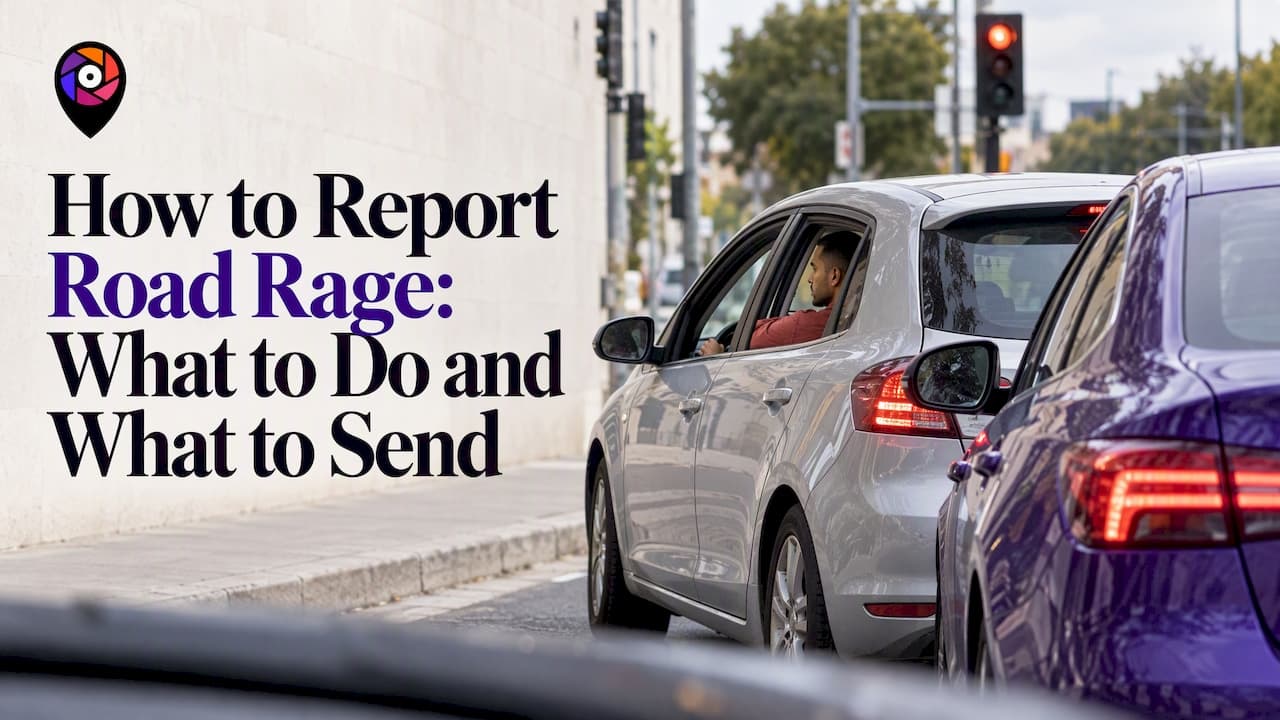
If someone is threatening you, chasing you or driving in a way that puts people in danger right now, call 911. If the incident is over, or the driver was reckless but nobody was in immediate danger, report it to your state patrol or local police with the vehicle description, plate number, location, time and direction of travel, plus video if you have it. This guide covers both cases, what to do in the moment, and what makes a report useful.
TL;DR
- Emergency or in progress: call 911. Police agencies in the US, Canada, the UK and New Zealand all draw the line at immediate danger, violence, threats or a crime happening now.
- Past incident or repeated pattern: use your state patrol, local police non-emergency line or online form. Vermont's DMV, for example, sends past incidents to the responsible state-police barracks.
- Do not engage. Avoid eye contact, do not get out of your car, and drive to a busy public place or police station if you are followed.
- Strong reports include plate, vehicle description, exact place and time, and clear video. Some agencies will not accept screenshots or old footage.
- A dashcam app can record the incident and keep a time-stamped file ready to send, so you can focus on driving.
Table of Contents
- Is it road rage, aggressive driving or a crime?
- What to do in the moment
- When to call 911
- How to report aggressive driving when it is not an emergency
- What to include in your report
- What happens after you report
- Using a dashcam app to document an incident
- Promo: DashcamU, built for reporting
- Perspective
- Common mistakes that weaken a report
- FAQ
- Sources
Is it road rage, aggressive driving or a crime?
People use the terms loosely, and the difference matters because it decides where you report.
Aggressive driving is a pattern of dangerous behavior: tailgating, weaving, running lights, unsafe passing, ignoring merges. Road rage is when that behavior turns into a personal confrontation: threats, chasing, blocking your car, throwing things, or an assault. Police in England and Wales note that road rage is not a specific offence but can involve threats, assault, criminal damage or driving offences. The US works the same way in practice: the charge depends on what the driver actually did.
That gives you a simple way to sort what you saw:
| What happened | Where to report |
|---|---|
| Driver is threatening you, following you, or someone is in danger now | 911 |
| Someone is hurt, or a crash just happened | 911 |
| Deliberate damage to your car or property | Police, 911 if the person is still there |
| Reckless driving you witnessed, driver gone | State patrol or local police non-emergency line, or online form |
| Same driver or vehicle keeps doing it | Local police or state patrol, with every date and clip you have |
What to do in the moment
The report comes second. Getting out of the situation safely comes first.
The Rhode Island DMV advises that if someone rages at you, do not respond, avoid eye contact and stay calm. Stay in your vehicle, and if necessary drive to a busy public place where there are witnesses.
The New York DMV gives similar guidance in its defensive driving chapter: do not make eye contact, challenge the other driver or stop. Move away safely, stay in the vehicle if you are followed, drive to a police station, and report the vehicle description, location, plate number and direction of travel.
A few practical habits help:
- Create distance. Let the driver pass or change lanes safely. Winning a standoff is never worth it.
- Do not go home. If someone follows you, do not lead them to your address. Head for a police station or a lit, crowded place.
- Call 911 hands-free if you are being followed. Say where you are, what the vehicle looks like and which way you are heading.
- Do not film by hand. Holding a phone while driving is a hazard and illegal in many states. Mount the phone or use a camera that records on its own.
- Write it down once you are safe. Pull over somewhere secure and note the plate, make, model, color, location, time and what the driver did while it is fresh.
When to call 911
Call 911 when the incident is happening now, someone is in danger, or a crime is in progress. Police across several countries use the same test. Calgary Police tell residents to call 911 if there is an emergency, an incident is happening now or anyone is in immediate danger, including in a road-rage incident. New Zealand Police use 111 for serious risk to life or property or a crime happening now. London's Metropolitan Police separate emergencies, meaning immediate danger to life, violence, threats or a crime in progress, from road incidents that can be reported online.

Vermont's DMV states it plainly: aggressive driving in progress should be reported immediately by calling 911. Past incidents or recurring patterns go to the responsible state-police barracks.
A good rule: if you feel your safety is at risk, call. Dispatchers would rather get a call that turns out to be minor than miss one that is not.
How to report aggressive driving when it is not an emergency
Many states run a dedicated non-emergency number or an online form for reporting reckless drivers, and some cities use 311. The number and the process differ by state and by agency, so look at your state patrol or state police website, or your local police department's page, before you need it. Saving the number in your phone is a small step that pays off on a long highway drive.
Other countries show what a mature process can look like, and they are useful models for what US agencies increasingly expect:
- Calgary, Canada: police accept online traffic complaints and still images. Once an investigator is assigned, they send a link to upload video evidence.
- Toronto, Canada: the online system takes reports of dangerous or unlawful driving when no collision occurred, the driver is unknown and you have the plate and a short vehicle description. If a collision occurred or you know the driver, you contact police directly.
- Queensland, Australia: hooning and traffic complaints can be submitted with video or photos through an evidence submission portal.
- West Yorkshire, England: a dedicated portal for footage from drivers asks for contact details, vehicle details, date, time, location and the recording itself.
The pattern is the same everywhere: describe the vehicle, pin down the place and time, and attach clear footage.
What to include in your report
Police can only act on what they can verify. The Lincolnshire Police and Crime Commissioner's office notes that the quality of reporting can make a big difference: time frames, number of people, number plates, car color and clothing all help.
Use this checklist:
- License plate and state. This is the single most useful detail. Calgary Police ask you to identify the violator, for example with a plate.
- Vehicle make, model, color and any distinguishing marks. Dents, stickers, roof racks, commercial lettering.
- Exact location and direction of travel. Highway and mile marker, or cross streets.
- Date and time. To the minute if you can.
- What the driver did. Specific actions: ran a red light, brake-checked, cut across three lanes, threatened you.
- Description of the driver and any passengers, only if you saw them clearly.
- Witnesses. Other drivers who stopped, or passengers in your car.
- Video. See below.
Video: what agencies want
Requirements differ, so check the agency's page. Some examples show how strict they can be:
- Calgary asks for clear, shareable video showing the violation, and about two minutes before and after it if possible.
- ACT Policing in Australia requires video, not screenshots or photos, prefers a correct timestamp, and only accepts footage captured within the last 14 days. It also says officers look at the full recording and may examine the reporting driver's own conduct and how the footage was obtained.
- Queensland says you do not have to give personal details, but withholding them can affect police's ability to investigate and prosecute.
- West Yorkshire's portal requires you to be willing to attend court if required.
Two lessons apply anywhere. Report quickly, because old footage may not be accepted. And keep the original file, unedited, with its timestamp. If your own driving was careful and your recording was steady, the clip speaks for itself.
What happens after you report
Expect less than you hope for, and do not read silence as indifference. Ask the Police in England and Wales explain that officers consider the circumstances and the evidence. If attendance is needed or there are viable lines of enquiry, an officer is assigned and you get a reference number. If there is nothing further to pursue, they tell you why. The same page notes that conduct which may be an offence can still go unprosecuted when independent evidence is thin.
Even then, reports have value. Queensland Police say they use reports to understand local traffic behavior, shape road policing strategies and investigate offences. A repeated location or a repeated vehicle can change where patrols go.
If you were the target of threats, violence, deliberate damage to your vehicle, or abuse aimed at your race, religion, sexual orientation, disability or gender, say so clearly in the report. Police guidance in England and Wales lists these as the cases to report. If you are injured or shaken, see a doctor, and keep your insurer informed if your car was damaged.

Using a dashcam app to document an incident
Memory under stress is unreliable. You may remember the road rage but not the plate. A camera that is already recording solves that, and a smartphone in a windshield mount can do the job without a new device.
What to look for in an app or any dashcam setup:
- Automatic loop recording so you never have to press anything while driving.
- Readable plates in the frame, which means a stable mount and a clean windshield.
- Accurate timestamp and location data attached to each file.
- Incident protection that saves the clip when something happens, so it is not overwritten.
- Easy export in a format an agency can accept.
- Clear privacy handling, since footage shows other people. Privacy rules vary by country and state, and some places restrict audio recording, so check local law.
Set it up before you drive, not during an incident. Mount it, check the angle, and confirm the storage is not full.
Promo: DashcamU, built for reporting
We built DashcamU to turn your smartphone into a dashcam that records, detects incidents and helps you report traffic violations and dangerous driving. It is designed to support anonymous reporting, automatic crash detection (we measure it at 98.2% accuracy), nearby accident alerts and a reward system for successful penalty submissions. It also works with Bluetooth buttons and DVRs. Reporting rules depend on where you live, so always check how your local agency accepts evidence.

You can see what the app does and get started on the DashcamU app page.
Perspective
Most people who witness dangerous driving never report it. The reason is rarely that they do not care. It is that reporting feels like work: you are shaken, you did not catch the plate, and you do not know whom to call or what to send.
We designed DashcamU to remove that friction. A phone that is already recording means the evidence exists when you need it. Automatic submission to authorities means you do not have to sort through files at the roadside or hours later. And anonymity matters because many drivers hesitate to report out of fear of retaliation from someone who is already angry.
We also think the system works best when reporting is rewarded rather than treated as a burden. Our reward model is built around successful penalty submissions, so the people who help make roads safer have a reason to keep doing it. Rules differ by country and the legal framework is still maturing in many places, but the direction is clear: better evidence, faster response, safer roads. Insurers also see the value of reliable incident data, which is a theme we explore in our piece on insurance telematics.
Oleksiy
Common mistakes that weaken a report
- Waiting too long. Details fade and some agencies set a cutoff for footage.
- Reporting only a feeling. "He was driving crazy" gives police nothing. "Silver sedan, plate ending 482, changed lanes four times without signaling on I-90 eastbound at 5:40 pm" does.
- Editing the clip. Cropping, filters or compilations make evidence harder to use. Send the original.
- Confronting the driver afterward. Do not approach, follow or post the footage online as a substitute for reporting.
- Exaggerating. State what you saw. As ACT Policing notes, a report is not automatically proof of an offence, and officers assess the whole recording.
- Skipping the call when you were threatened. A threat or deliberate damage is a police matter, not just a bad drive.
FAQ
Should I report road rage to the police?
Yes, when there are genuine threats, assault, deliberate damage to your vehicle or property, or abuse aimed at who you are. Guidance from police in England and Wales lists these as the cases to report. For reckless driving that did not escalate, a non-emergency report with the plate and details still helps build a pattern.
Can you call the police on road rage?
Yes. Call 911 if it is happening now or you feel unsafe. If you are being followed, drive to a police station or busy public place rather than home, and stay in your vehicle.
What should I do when someone road rages on me?
Do not respond. Avoid eye contact, ignore gestures, stay calm and do not get out of your car. Let the driver pass, and if needed head for a place with witnesses. Report it once you are safely parked.
What do I need to report an aggressive driver?
The plate, vehicle description, location, direction, date and time, and a plain account of what the driver did. Video helps a great deal, but check the agency's rules: some, like ACT Policing, accept only video and only if it is recent.
Can I report aggressive driving through an app?
Some agencies take online reports and video uploads, and a dashcam app can supply the footage and details. Whether an app can submit directly depends on your location and the authority, so confirm what your local police or state patrol accepts before you rely on it.
Sources
- Ask the Police: victim of road rage
- Rhode Island DMV: Responding to Aggressive Driving and Road Rage
- New York DMV: Defensive Driving
- Calgary Police: Traffic and Collision Reporting
- New Zealand Police: How to report a crime or incident
- Metropolitan Police: Report a road traffic incident
- Vermont DMV: Aggressive Driving
- Toronto Police: Online Citizen Police Reporting System
- Queensland Police: Reporting Hooning or Traffic Complaint
- West Yorkshire Police: Op Snap
- ACT Policing: Dangerous Driving and FAQs on reporting
- Lincolnshire Police and Crime Commissioner: How to Report a Crime