
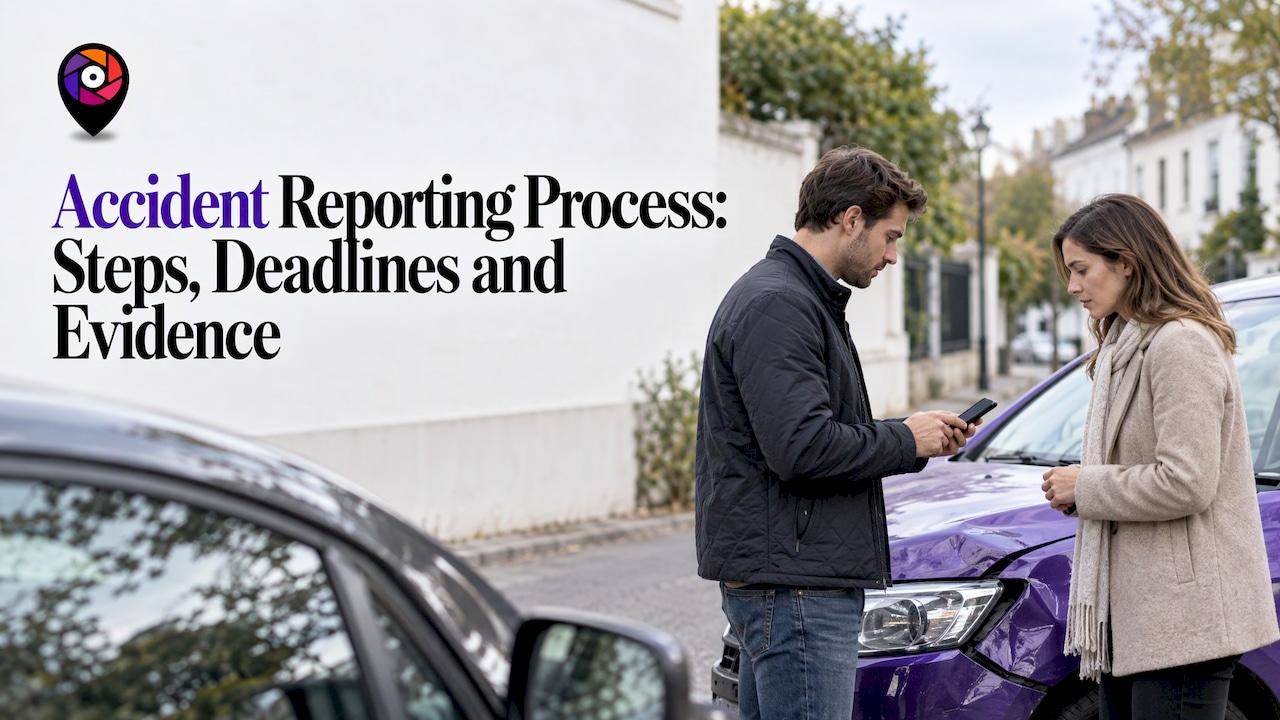
The accident reporting process for a road crash has five parts. Make the scene safe and get help for anyone hurt. Exchange details. Report to the police if your jurisdiction requires it. Notify your insurer. Then file any separate report your motor vehicle agency asks for. Deadlines differ by place, and in the US they differ by state, so the fastest way to stay safe is to collect evidence at the scene and check your own state's rules the same day.
This guide walks through each part in order. It also shows how the process works in several countries, because the same logic of safety, evidence, authority and insurer repeats everywhere, while the numbers change. If you are searching for the workplace version of this topic (an employer's incident investigation), the principles of fast reporting and accurate facts apply too, but this article focuses on road accidents.
TL;DR
- Stop, make the scene safe, check for injuries and call emergency services if anyone is hurt or the road is blocked.
- Exchange names, contact details and insurance information, and do not admit fault or speculate about the cause.
- Police and agency reporting thresholds depend on injury, damage amount and local law, so look up your state or country the same day.
- Notify your insurer promptly, with photos, video, witness details and a short written account ready.
- Video recorded at the moment of the crash is the evidence that is hardest to dispute later.
Table of Contents
- Step 1: Make the scene safe and get help
- Step 2: Exchange information without admitting fault
- Step 3: Decide whether to report to the police
- Step 4: Know your deadlines
- Step 5: Notify your insurer
- Step 6: What happens after you report
- Reporting a traffic violation you witnessed
- Why video evidence changes the process
- Perspective
- Get the footage before you need it
- A one-page checklist for your glove box
- Common mistakes that weaken a report
- FAQ
- Sources
Step 1: Make the scene safe and get help
Safety comes before paperwork. Official guidance in the UK tells drivers to stop at the scene as soon as it is safe, switch off the engine, turn on hazard lights and check for injuries. The same guidance says to call emergency services when someone is in danger or seriously hurt, when you believe a serious offence has been committed, or when the crash has blocked the road or created a dangerous obstruction.
In the US the number is 911. The rule of thumb is the same: if there is any injury, any doubt about an injury, fire, fuel leaking, or a vehicle in a live lane, call first and sort out the rest afterward. A dispatcher will tell you whether to stay on the line and whether to move your car.
A few habits make the first ten minutes easier:
- Turn on hazard lights and, if you can do it safely, put out warning triangles or flares.
- Move to the shoulder only if the car is drivable and nobody is seriously hurt. Insurance-industry guidance stresses assessing injuries first and making the area safe before you do anything else.
- Do not stand in traffic lanes to take photos. Photograph from the shoulder or a sidewalk.
- Keep your seat belt on if you are waiting in a car on a busy road and it is unsafe to get out.
If you drive with a phone-based recorder running, it keeps recording through this stage. That footage often captures the moments you will not remember clearly later.
Step 2: Exchange information without admitting fault
Even a minor collision needs an exchange of details. Justia's overview of US reporting duties lists the usual items: name and address, driver's license number, vehicle registration number, and insurance company and policy number.
Keep the conversation factual. Insurance-industry guidance recommends exchanging details without admitting fault or speculating. "I'm so sorry" is human, but "I didn't see you" can be quoted later. Say what you need to say to be polite and leave the analysis to the adjusters.
What to write down or photograph
Official reporting forms tell you what a complete report contains. Singapore's police, for example, ask for the date, time and location, the names and ID numbers of the people involved, witnesses, vehicle damage and positions, other vehicles' registration numbers and a brief account of what happened. Estonia's police recommend a standard accident form, and if none is available, a plain-paper note with the exact location, driver and vehicle details, witnesses, a short description and a diagram showing vehicle positions and trajectories.
You can borrow that checklist anywhere:
| Item | What to capture |
|---|---|
| When and where | Date, time, street, nearest cross street or mile marker, direction of travel |
| People | Names, phone numbers, license numbers, passengers, witnesses |
| Vehicles | Plate numbers, make, model, color, insurer and policy number |
| Damage | Wide shots, close-ups of every damaged area, debris, skid marks |
| Conditions | Weather, lighting, road surface, signs, signals, construction |
| Account | Your own short written version, written the same day |
| Authorities | Officer names, badge numbers and the report or case number |
Add a quick sketch with arrows showing where each vehicle was and where it ended up. A simple drawing made at the scene is more reliable than a description reconstructed days later.
Step 3: Decide whether to report to the police
Whether you must report to the police depends on where you are. The pattern is consistent: injuries, deaths, hit-and-runs and larger property damage trigger a legal duty, while a minor, undisputed fender bender may not.
In the US, nearly all states require a police report when there is an injury or death, or when property damage passes a set amount. That amount varies by state, so look it up on your state police or DMV website. Even where it is not mandatory, calling the non-emergency line for a report number is often wise, because insurers ask for it.
The same trigger logic appears elsewhere:
- United Kingdom: No report is needed if details are exchanged, nobody is injured and no driving offence is alleged.
- Singapore: A report must be lodged for a fatality, certain injuries, damage to government property, a foreign vehicle, a pedestrian or cyclist, or a hit-and-run. It can be filed online or at a police station.
- Western Australia: You report to police and the state insurer online if the crash involves injury, property damage over $3000, or an unavailable owner of damaged property.
- South Africa: The report must be made in person at a police station, with your driving licence, and you receive an official reference number.
The lesson for a traveler or a driver who moves between states: do not assume your home rules apply. If in doubt, report. A report you did not strictly need costs you a phone call. A missing report you did need can cost you a fine or a rejected claim.
Step 4: Know your deadlines
People search "how long after an accident must it be reported" because the clock starts at the crash, not at the moment you feel ready. Here are examples from official sources, which show how much deadlines vary.
| Jurisdiction | Deadline in the source |
|---|---|
| South Africa | Within 24 hours if someone is killed or injured, otherwise the first working day after the accident |
| New Zealand | Injury crashes reported to police as soon as practicable and within 24 hours; property damage reported to the owner within 48 hours, or to police within 60 hours if the owner cannot be found |
| United States | Set by each state, and separate from police reporting where the DMV requires its own driver report |
The US point deserves attention. Justia notes that contacting the DMV is a separate requirement from reporting to the police, and many states ask you to file your own report if the crash meets certain thresholds. Drivers often assume the officer's report covers it. Check your state DMV's accident reporting page and put the deadline in your phone calendar the day of the crash.
Step 5: Notify your insurer
Tell your insurer early, even if you were not at fault and even if you do not plan to claim. Policies commonly expect prompt notice, and a delay hands the other side room to dispute the facts.
Some systems tie insurer notice directly to the police decision. In Singapore, when a police report is not required, parties exchange particulars and report to their own insurers under the Motor Claims Framework. Estonia goes further with a digital option: drivers can file a report from a smartphone with photos, and once confirmed it is sent to the insurer of the driver's choice.
When you call your insurer, have these ready:
- Your policy number and the police report number, if there is one
- The other driver's details and insurer
- Your photos, video and the written account you made
- The names and numbers of witnesses
- The location of your vehicle and whether it can be driven
Stick to facts. Describe what happened and what you saw, not what you assume the other driver was thinking.
Step 6: What happens after you report
Expect less contact than you imagine. For driving-offence reports in the UK, reports are assessed and you are contacted only if more information is needed. Depending on the evidence, the allegation may not be pursued, may lead to a Notice of Intended Prosecution, or may bring you in as a witness if it reaches court.
For your own claim, the sequence is usually: a claim number, an adjuster who reviews the report and evidence, a damage estimate, and a decision about liability. Keep a folder (digital is fine) with every email, estimate, medical record and receipt. Note the date and name each time you speak with someone.

Reporting a traffic violation you witnessed
Not every report is about a crash you were in. Sometimes you saw a driver run a red light, drive aggressively or pass a stopped school bus, and you want authorities to know.
Police generally need evidence they can act on. Calgary Police Service, for example, defines a traffic complaint as a violation of provincial traffic law you personally observed by a moving vehicle, and it requires video that clearly shows the violation. Where possible they ask for about two minutes before and after the incident, and still images can also be uploaded. Rules differ in the US by city and state, so look for your local police department's traffic complaint page.
If you are going to report, keep it factual and safe:
- Never film while driving unless the device is mounted and running hands-free.
- Note the plate, vehicle description, time and exact location.
- Submit the clip uncut, with a short factual description.
- If someone is in immediate danger, call 911 rather than filing a report.
We cover this in more detail in our guides on who to call about unsafe drivers and what to send after a road rage incident.
Why video evidence changes the process
A report is a claim about what happened. Evidence turns it into a record. Two drivers who disagree about who had the green light will each tell a convincing story, and without a recording, adjusters and officers have photos of damage and two accounts to compare.
Footage helps in specific ways:
- Timing: A recording shows the sequence of events, including the seconds before impact.
- Location and time stamps: These fill the first lines of every report form without guesswork.
- Third-party conduct: Plates, lane positions and signals are visible.
- Hit-and-run cases: A plate captured as a vehicle leaves can be the difference between a lead and nothing.
You do not need special hardware to start. A smartphone on a mount can work as a dashcam, and that is the idea behind the app we build. If you are curious about how automated detection works on the road, read our explainer on traffic violation detection.
Perspective
Most people think about the accident reporting process only after the accident, when they are shaken and trying to remember details. That is the worst time to build a record.
We built DashcamU around a simple idea: the record should already exist. Our app turns a smartphone into a dashcam, and its crash detection is designed to recognize an impact automatically, with a stated accuracy of 98.2%. When a crash happens, the footage is saved without you having to touch anything, and help can be alerted faster.
We also believe reporting should not be a burden or a risk. That is why anonymity is built into how the app submits traffic violations, and why we work toward a reward system for successful submissions as the legal framework allows. When reporting is easier, more of it happens, and safer roads follow.
Oleksiy
Get the footage before you need it
If you want a recording ready for the next time you need to file a report, DashcamU turns your phone into a dashcam that records your drive, is designed to detect crashes automatically, and can submit evidence of traffic violations anonymously.

You can see how the DashcamU app works and decide whether it fits the way you drive. Our app is also designed to work with Bluetooth buttons and DVRs, so you can save a clip with one press. To learn how the reward side works, read about how drivers get paid for safer roads.
A one-page checklist for your glove box
Save this list in your phone notes or print it.
At the scene
- Check yourselves and others. Call 911 if anyone is hurt or the road is blocked.
- Hazard lights on. Move to safety if the car is drivable and it is allowed.
- Photograph vehicles, plates, damage, road, signs and signals.
- Exchange names, phone numbers, license and insurance details.
- Get witness contact details before they leave.
- Ask police for a report number if they attend. Do not argue about fault.
Within 24 hours
- Write your account while it is fresh, including the time, direction and speed.
- Back up photos and video to a second place.
- Notify your insurer and record the claim number.
- Look up your state's police and DMV reporting rules and deadlines.
Within the first week
- File any state or DMV report that applies.
- See a doctor if you have any pain, even mild. Symptoms can appear late.
- Keep receipts for towing, repairs, rentals and medical costs.
Common mistakes that weaken a report
- Waiting to see how you feel. Deadlines run from the accident, not from when you decide it is serious.
- Assuming the officer filed everything. Insurer and DMV reports can be separate duties.
- Guessing in your statement. Write what you saw. If you do not know the speed, say so.
- Deleting footage or photos. Keep originals even if they seem unflattering or irrelevant.
- Skipping witnesses. A bystander's phone number can matter weeks later.
- Taking the other driver's word on insurance. Photograph their card and plate yourself.
The common thread is time. The sooner your account, photos and footage are saved, the less room there is for disagreement.
FAQ
What are the steps of the accident reporting process?
Make the scene safe and call emergency services if anyone is hurt. Exchange details, document the scene, and report to police if your location requires it. Then notify your insurer and file any separate agency report, such as a DMV form, within its deadline.
How long after an accident must it be reported?
It depends on where you are. South Africa sets 24 hours for injury or death and the first working day for other cases, and New Zealand sets 24 hours for injury crashes. In the US the deadline is set by your state, so check your state DMV and police websites on the day of the crash.
Do I need to report a minor accident with no injuries?
Not always. UK police say a report is unnecessary if details were exchanged, nobody was hurt and no offence is alleged. In the US, most states require a report once damage passes a set amount, and your insurer will usually want to hear about it either way.
What evidence should I include in an accident report?
Include the date, time and location, the people and vehicles involved, witnesses, photos of damage and positions, and a short account of what happened. Video recorded at the time is the strongest addition because it shows the sequence of events.
Sources
- Road collisions and incidents | Police.uk
- What to do during and after a vehicle accident | MIB
- Reporting Traffic Accidents and Offences | Singapore Police Force
- Services | South African Police Service
- Report a traffic crash | Western Australian Government
- Traffic crash report | New Zealand Police
- What to do in the event of a traffic accident | Estonian Police and Border Guard Board
- Traffic and Collision Reporting | Calgary Police Service
- Reporting a Car Accident & Legal Requirements | Justia