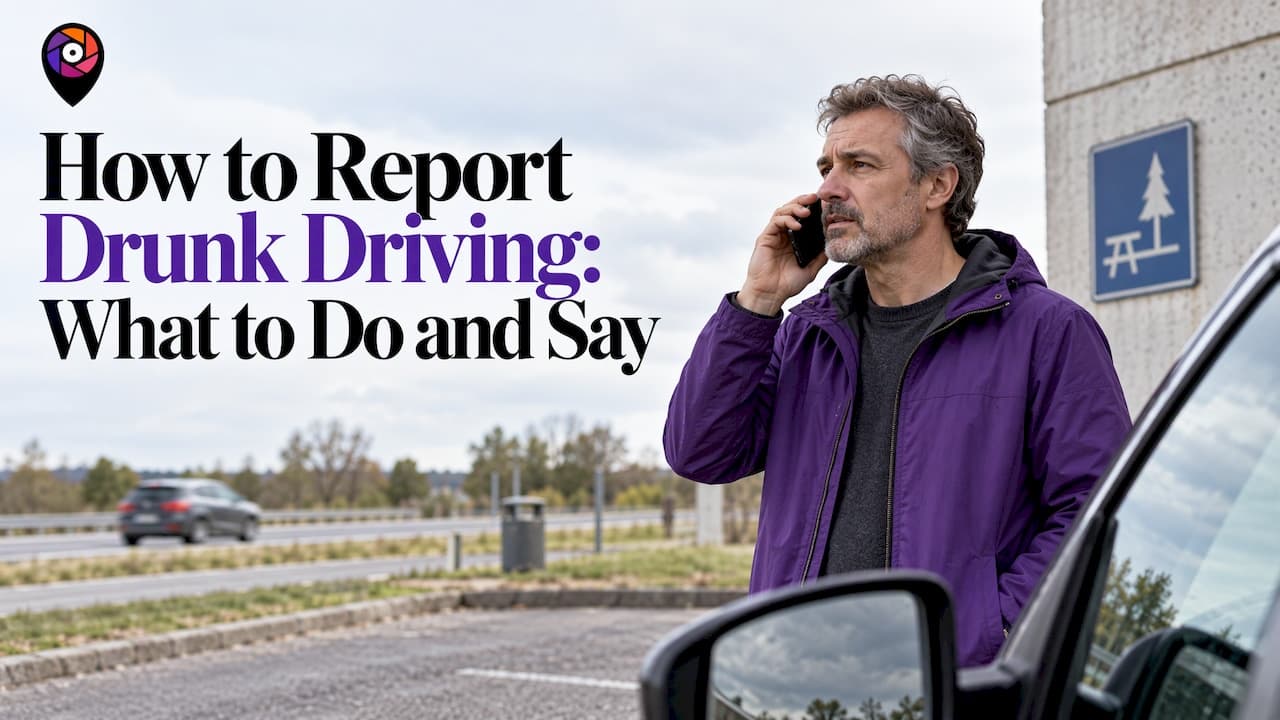
If you see a driver who looks impaired, call 911 and stay well back. Give the dispatcher the exact location, the direction of travel, a description of the vehicle and a plain account of how it is being driven. If you are behind the wheel, pull over first or hand the call to a passenger. Leave the stop to the police.
This guide covers who to call in the US, what to say, how to keep yourself safe, what to do when the car is already gone, and how reporting works in a few other countries.
TL;DR
- Call 911 for a driver who is weaving, speeding up and slowing down, or otherwise acting dangerously. Some states also run a short-code line, such as *GSP in Georgia or *CSP in Colorado.
- Keep your distance, wear your seat belt and never try to stop or follow the driver closely. If you are driving, pull over or have a passenger call.
- Give four things: where you are, which way the car is heading, what it looks like (plate if you can read it) and how it is being driven.
- If the driver is gone and nobody is in immediate danger, use your local police non-emergency line and share what you noted.
- If someone you know is about to drive drunk, act before they reach the car.
Table of Contents
- Who to call to report a drunk driver in the US
- Stay safe first: what to do before you pick up the phone
- What to tell the dispatcher
- If you are a passenger: capturing details
- Can you report a drunk driver anonymously?
- What if the driver is already gone?
- Reporting an impaired driver outside the US
- Our perspective: why details decide whether a report works
- Where DashcamU fits in
- When the impaired driver is someone you know
- A checklist to keep in your head
- FAQ
- Sources
Who to call to report a drunk driver in the US
The default answer is 911. The California Highway Patrol tells the public to call 911 to report a dangerous driver, pull over or have a passenger place the call, and give the dispatcher a location and details about the car. MADD's guidance for concerned citizens also lists calling 911 with the exact location as the final step after you have gained some distance and noted the plate and distinguishing details.
Many states add their own shortcuts for cell phones:
- Georgia: the Department of Public Safety asks people to call *GSP or 9-1-1 to report impaired drivers.
- Colorado: the State Patrol directs callers to dial *CSP (*277), and the call is free.
- California: the CHP uses 911 for dangerous drivers, as above.
The pattern is the same everywhere: an emergency line or a state patrol shortcut, answered by a dispatcher who sends an officer. Because shortcuts differ by state and sometimes by carrier, 911 is the number to memorize. If you travel often, check your state patrol's website for its code and save it in your phone.
When should you use 911 rather than a non-emergency line? If the car is on the road right now and being driven dangerously, that is an emergency. A vehicle swerving across lanes can kill someone in the next minute, and a dispatcher can only help if the car is still findable.
Stay safe first: what to do before you pick up the phone
A report is only useful if you get through the situation unharmed. Police and traffic-safety groups agree on a short list of rules.
Keep your distance. The CHP advises that if a car is weaving dangerously, you stay far enough away to avoid danger. The City of Merced police department adds that you should stay far behind the driver and wear your safety belt.
Never call while driving without a plan. MADD Canada reminds drivers to use extreme caution with a cell phone and to pull over first. The CHP says to pull over or use a hands-free device, or to have a passenger call. If you are alone, the safest option is to find a safe place to stop, such as a parking lot, a wide shoulder or a gas station, and then dial.
Do not play police officer. The same MADD Canada reminders tell witnesses to let officers do their job and never try to apprehend the impaired driver. Do not tailgate, box the car in, flash your lights repeatedly or wave the driver over. An impaired driver may react unpredictably, and you become a second hazard on the road.
Confrontation is a bad idea with strangers. Drinkaware, a UK charity, notes that police advise you should only talk to someone about not drink driving if it is safe to do so. It is a smart idea with a friend, but with a stranger you should think twice because they may become violent or abusive. If you are in a bar, it suggests telling security or bar staff, who are trained to step in safely.

What to tell the dispatcher
Dispatchers work through a standard set of questions. The more of these you can answer in the first thirty seconds, the faster an officer can find the car. Colorado State Patrol asks callers for the exact location (road and direction), a description of the vehicle, and the manner in which it is being driven. MADD adds that you should give the road name or cross streets and a complete description of the vehicle and your reasons for suspecting impairment.
Here is a simple script to keep in your head:
| What the dispatcher needs | What to say | Example |
|---|---|---|
| Where you are | Road, nearest cross street or exit, mile marker | "Northbound on Route 9, just past Elm Street" |
| Direction of travel | Compass direction or toward a landmark | "Heading north, toward the mall" |
| The vehicle | Color, make, model, plate if readable, anything distinctive | "Silver sedan, dented rear bumper, plate starts with 4KT" |
| How it is driving | The specific behavior you see | "Drifting across the center line, braking hard for no reason" |
| Who you are | Your name and a callback number if you are willing | Dispatchers may ask; ask them how your details are handled |
SafeWise advises giving the license plate number, make, model and color, the location with street names or intersections, and a driver description if possible. It also notes that if you are not the one driving, taking a picture of the vehicle and plate may help.
Describe what you see, not what you conclude. "The car crossed the center line twice in the last mile" is more useful than "he is drunk." You cannot know the cause of bad driving, and a dispatcher or officer will decide that. Behavior is evidence.
Signs that a driver may be impaired
MADD Canada lists ten signs of impairment worth describing to a dispatcher. Several of the most common:
- Driving at inconsistent speeds
- Drifting in and out of lanes
- Tailgating or changing lanes frequently
- Making exceptionally wide turns
- Passing without enough clearance
- Stopping well before stop signs or lights
- Disregarding signals and lights
- Driving without headlights, or leaving turn signals on
- Driving with windows open in cold or bad weather
The full list is on MADD Canada's Campaign 911 page. One sign alone, such as a missed turn signal, does not make a drunk driver. A pattern of several signs, or one extreme sign like driving the wrong way, is what to report.
If you are a passenger: capturing details
Passengers have the advantage here. While you call, you can also write down or photograph what you can see, as long as it does not distract the driver or put anyone at risk. The most valuable details are the plate, the vehicle description and the exact spot where you saw the behavior.
If you are the driver, do not film or type while moving. Memorize the plate, then pull over and write it down. Our own guide on reporting unsafe drivers walks through who to call and what to say for general dangerous driving, and the same habits apply: stay calm, be specific and let the authorities act.
Can you report a drunk driver anonymously?
In the US, the standard way to report a car in progress is a direct call to 911 or a state shortcut, and the dispatcher will usually ask for your contact information so an officer can follow up if needed. If privacy is a concern, tell the dispatcher at the start and ask how your details are handled. Do not let the question delay a call about a car that is on the road right now.
Other countries have well-established anonymous channels. In the UK, Crimestoppers accepts information about suspected regular drink or drug drivers 100% anonymously by phone on 0800 555 111 or online, and says its guarantee of anonymity has never been broken in over 38 years. Its drink-driving form asks for details such as the vehicle registration, make and model, regular routes and timings, which suits someone who knows a repeat offender rather than a stranger on the highway.
What if the driver is already gone?
Sometimes you notice a driver only after they have parked, or you arrive at a scene after the car has left. Then the question is whether anyone is in immediate danger.
- Car still on the road or about to leave: call 911 or your state shortcut. An officer may be able to intercept.
- Car already left and nobody is in immediate danger: contact your local police department's non-emergency number, and share the plate, vehicle description, location, time and what you saw.
- Someone you know drives drunk regularly: a report to local police is still appropriate, and in the UK there is a dedicated anonymous route, as above.
The UK and Australian authorities draw the same line between urgent and non-urgent. Drinkaware says that if the drink driving has already happened, you can call the police on 101 or Crimestoppers on 0800 555 111. Australia's National Heavy Vehicle Regulator tells people that for something that happened earlier or is not an immediate danger, they should call PoliceLink on 131 444.
Reporting an impaired driver outside the US
Our readers drive all over the world, so here is how the main systems compare. Numbers and procedures can change, so confirm on the official page before you rely on them.
| Country | Emergency, driver on the road now | Non-urgent or after the fact | Anonymous option |
|---|---|---|---|
| United States | 911 or state shortcut | Local police non-emergency line | Ask the dispatcher how your details are handled |
| Canada | 911 (Campaign 911) | Local police | Check your local police or crime stoppers program |
| United Kingdom | 999 | 101 (GOV.UK) | Crimestoppers, 0800 555 111 |
| Australia (NSW) | Triple Zero (000) | Police Assistance Line 131 444 (Service NSW) | See state police |
| Australia (Queensland) | Triple Zero (000) | Online or 13 HOON (13 46 66) (Queensland Government) | See state police |
In Canada, MADD Canada's Campaign 911 encourages the public to report suspected impaired driving by calling 911, and it describes impaired driving as the number one criminal cause of death in the country. In the UK, GOV.UK says to call 999 if the crime is in progress, 101 for non-emergencies, and Crimestoppers to report anonymously. In New South Wales, Service NSW says to call Triple Zero if a driver appears to be under the influence or is still at the scene. In Queensland, the government tells you to give police the vehicle's registration, the location and time, how the person was driving and whether there were witnesses.
Our perspective: why details decide whether a report works
We built DashcamU because we kept seeing the same gap: drivers who witness dangerous behavior on the road and have nothing to show for it except a vague memory. A dispatcher can only act on what you can give them, and under stress most of us forget the plate, the direction or the exact cross street within minutes.
When it comes to a suspected drunk driver, the first rule never changes: call 911, keep your distance and let trained officers handle the stop. No app replaces that call. Where we think technology helps is everything around it. A phone that records the road gives a passenger, or the driver later, a clear record of the plate, the vehicle and the manner of driving, so the details you pass on are accurate rather than guessed.
Our app turns a smartphone into a dashcam, captures and anonymously reports traffic violations, and includes automatic crash detection, which we describe as 98.2% accurate. That crash detection is designed to help get rescue and medical services moving faster when something does go wrong. We also believe that people who take the trouble to document violations should be recognized for it, which is why DashcamU is designed around a reward system for successful penalty submissions.
Safer roads come from many people doing small, responsible things: calling it in, noting the details, never taking risks themselves. We want to make the careful version of that easier.
Oleksiy
Where DashcamU fits in
DashcamU is a free mobile app that turns your phone into a dashcam. It records your drive, can detect crashes automatically, and lets you submit evidence of traffic violations anonymously. It also supports Bluetooth buttons and DVR integration, so you can mark a moment without touching the screen.
For a suspected drunk driver, your first action is still the 911 call. Having a recording of the road running in the background means you have footage of the plate and the driving pattern to refer to afterward. You can read how the technology works in our guide to traffic violation detection, or see how the program pays contributors in our explainer on driving rewards.

Ready to try it? Get the DashcamU app and have a dashcam in your pocket on every drive.
When the impaired driver is someone you know
Most drunk-driving tragedies are preventable earlier than the moment someone turns the key. MADD USA says the best way to prevent impaired driving is to plan ahead with a sober designated driver that everyone agrees to in advance. If all else fails, it says to call law enforcement, because it is better to have a friend arrested than injured or killed.
Some practical ways to act before the car moves:
- Raise it early. If you are at a party or a bar, speak up before the third drink, not as the person reaches for keys.
- Offer a real alternative. A ride, a couch, a taxi or a rideshare you will pay for removes the excuse.
- Use staff. Bar and restaurant staff are trained to handle this safely, as Drinkaware notes.
- Call if they leave anyway. Give the dispatcher the plate, the direction they left and where they were headed.
If the driver is a stranger, do not step in. Report and keep your distance.
A checklist to keep in your head
You will not have time to read an article when it happens, so practice the sequence once:
- Put distance between you and the car.
- Buckle up and make sure you are not holding a phone while moving.
- Find a safe place to stop, or hand the phone to a passenger.
- Dial 911 or your state shortcut.
- Say where you are, which way the car is going, what it looks like and what it is doing.
- Stay on the line as long as the dispatcher wants you to.
- Do not follow if told not to, and never try to stop the car yourself.
Write your state's patrol shortcut in your phone contacts now. Having it ready costs nothing and makes the call faster.
For related situations, such as aggressive or erratic driving that is not obviously impaired, see our guide to reporting road rage.
FAQ
Who do I call to report a suspected drunk driver?
In the US, call 911. Some states also have a patrol shortcut, such as *GSP in Georgia or *CSP in Colorado. Give the dispatcher your location, the direction of travel, a description of the vehicle and how it is being driven.
Is it safe to follow a drunk driver while I report them?
No. Keep a safe distance, wear your seat belt, and never try to apprehend the driver. If you are driving, pull over before you call or have a passenger do it. Police can find the car from the details you give.
Can I report an impaired driver anonymously?
It depends on where you live. In the UK, Crimestoppers takes anonymous information by phone or online. In the US, tell the dispatcher you are concerned about privacy and ask how your details are handled, but do not delay the call about a car on the road right now.
What if I only noticed the driver after they left?
If no one is in immediate danger, contact your local police non-emergency line with the plate, vehicle description, location and time. If the car is still nearby or about to leave, treat it as an emergency and call 911.
Can a photo or video help my report?
It can, if you are a passenger and it does not put anyone at risk. SafeWise notes that a picture of the vehicle and license plate may be helpful. Never film while driving.
Sources
- Report Driving Under the Influence, California Highway Patrol
- How to report impaired drivers, Georgia Department of Public Safety
- Report a DUI/DUID Driver, Colorado State Patrol
- Drink. Drive. Get arrested., City of Merced
- Spotting & Preventing Impaired Driving, MADD
- Campaign 911, MADD Canada
- How to Report a Drunk Driver, SafeWise
- How to report a drink driver, Drinkaware
- Drink and drug driving, Crimestoppers
- Giving information, Crimestoppers
- Give information, drink driving, Crimestoppers
- Report a crime, GOV.UK
- Report a traffic crash with NSW Police, Service NSW
- Report a dangerous driver, Queensland Government
- Road rule violation, National Heavy Vehicle Regulator